


The State And Social System In The USSR
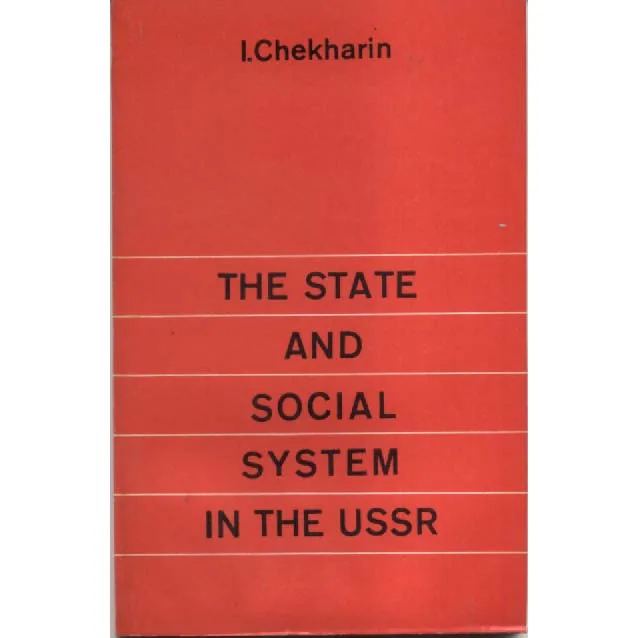
Publisher: Novosti Press Agency
Format: Paperback
ISBN: none
There are ordinary political books, and then there are Soviet-era publications produced with the unwavering confidence of a civilisation entirely convinced it had solved history itself. The State and Social System in the USSR by I. Chekharin is one such magnificent relic from the ideological front lines of the Cold War: a 1974 Novosti Press Agency paperback calmly explaining the Soviet system with the sort of certainty modern governments can only dream about.
This is not a hesitant or self-questioning book. There are no nervous “on the other hand” moments here. No fashionable ambiguity. No “both sides make valid points.” Instead, the USSR strides onto the page like a concrete hydroelectric project in literary form, determined to explain labour, governance, social organisation and collective progress whether the reader is fully prepared or not.
Published by Novosti Press Agency — effectively the Soviet Union’s international publishing voice — the book belongs to that fascinating era when global superpowers still believed political influence could be spread through earnest paperbacks posted around the world. Somewhere in 1974, somebody almost certainly handed this to a student in Britain or France believing it might genuinely help usher in a brighter socialist future.
The title itself is gloriously functional. The State and Social System in the USSR. No dramatic flourish. No marketing gimmicks. It sounds less like a book and more like a briefing folder issued before touring a tractor factory outside Minsk. One half expects each chapter to conclude with statistics regarding steel production and a subtle reminder that capitalism is spiritually exhausted.
And yet, whatever one’s politics, books like this are now undeniably fascinating historical artefacts. Reading Soviet political literature today feels a bit like opening a time capsule from an alternative future that never quite arrived. The certainty is astonishing. The confidence almost admirable. Entire systems of economics, governance and society are explained with the calm assurance of a man drawing five-year plans on graph paper while smoking heavily in a state office.
Naturally, modern readers may notice that the text occasionally leans very enthusiastically toward the official Soviet interpretation of reality. This is part of the charm. The book now exists in that wonderful territory between political theory, propaganda, history and cultural archaeology. It preserves not only arguments, but atmosphere — the intellectual climate of the Cold War itself.
Physically, Soviet paperbacks also possess a wonderfully severe aesthetic. The covers often appear designed according to strict principles of efficiency, seriousness and minimal emotional excitement. Incredibly, this now makes them look oddly stylish. Mid-century Soviet publishing has somehow evolved from ideological necessity into accidental retro design chic.
This particular copy is listed as Fair, with a slight damp effect to the bottom, though nothing serious. Which, if anything, only enhances the historical authenticity. One likes to imagine it surviving decades in a cold attic, student bedsit or overfilled political bookshelf somewhere while the entire geopolitical order quietly transformed around it. Compared to the collapse of the Soviet Union itself, a little dampness feels relatively minor.
There is also something deeply ironic about the survival of books like this in secondhand shops. Once distributed as instruments of ideological persuasion, they are now bought by collectors, historians, designers, retro enthusiasts and curious readers who simply enjoy owning obscure remnants of vanished systems. Capitalism, in one of its stranger twists, now happily resells Soviet explanations of why capitalism was doomed.
An excellent addition for collectors of Cold War history, Soviet ephemera, political literature, or anyone whose ideal bookshelf contains at least one book that appears to have escaped from a government ministry sometime around the Brezhnev era.
Keep browsing: See more Politics books Other books by I Chekharin
